
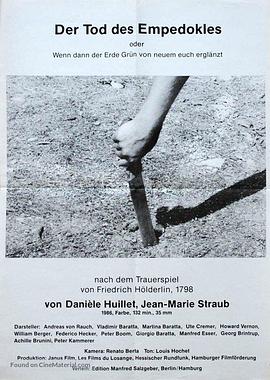
恩培多克勒之死
The subject of Danièle Huillet and Jean-Marie Straub’s Der Tod des Empedokles (The Death of Empedocles, 1987) is the Greek pre-Socratic philosopher Empedocles (c. 490 BC – 430 BC), who lived in the Greek colony of Agrigentum in Sicily. His theories are mentioned in several of Plato’s dialogues. He maintained that all matter is made up of four irreducible elements water, earth, air and fire. A mystic and a poet, he is considered to be the founder of classical rhetoric. He is also thought to be the last Greek philosopher to write in verse; two fragments of his works survive Katharmoi (Purifications) and Peri Phuseôs (On Nature). An advocate of democracy, he came into conflict with his fellow citizens of Agrigentum and, as result, was banished with his young disciple, Pausanius. When he was asked to return, he preferred to commit suicide by throwing himself into the active volcano at Mount Aetna. The German writer Friedrich Hölderlin wrote two versions of Der Tod des Empedokles in 1798 and 1800, and a final third version in 1820, all three ultimately unfinished. They were conceived as five-act tragedies and all three differ in plot. According to Michael Hamburger, Hölderlin’s English-language translator, the main reason why Hölderlin finished no version of the play must be that he remained too closely identified with Empedocles, at the very period in his life when his own view of the poet as philosopher, prophet and priest – and as tragic hero – was subject to perpetual crisis and re-examination. Huillet-Straub’s The Death of Empedocles is based on Hölderlin’s first version (the longest of the three), whereas Black Sin is based on the third version.
 除暴之路
除暴之路
 爸爸咪呀
爸爸咪呀
 我为你含苞待放
 戴高乐之战:淬炼时代
 夏日无限综合症
 头号粉丝2026
 旧爱来信
旧爱来信
 冰室莲司:日本统一
 伪钞之王
伪钞之王
 羽毛球
羽毛球
 寻找艾米丽
寻找艾米丽
 顺风车杀手
顺风车杀手
